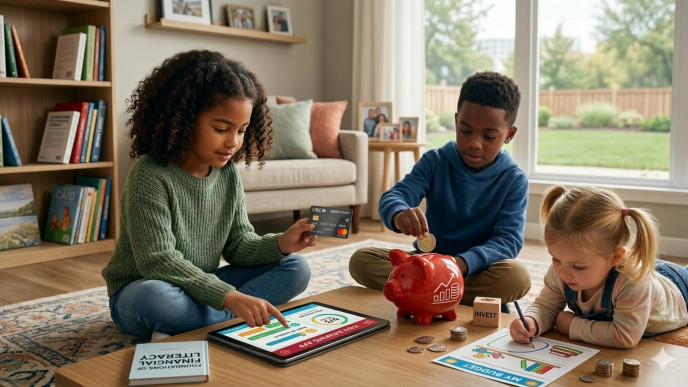
Opening a bank account for kids is one of those small moves that pays off for years. It gives your child a real tool to learn saving, spending, and how digital money actually works. The good news: nearly every major Canadian bank now offers a youth bank account with $0 monthly fees, so the barrier to entry is basically zero.
The harder part is figuring out which account fits your family. Some offer high interest rates, others come with prepaid cards and parental controls, and a few bundle in rewards programs. Here's a breakdown of the best youth bank accounts Canada has available right now, with current rates, fees, and features verified as of March 2026.
Why Open a Youth Savings Account for Your Child?
Keeping your kid's money in your own account is simpler, sure, but it skips the whole point. When children see their own name on a statement or a debit card, money stops being abstract. They start to understand that spending $12 at the mall means $12 less in their balance, not just a tap on Mom's phone.
A dedicated account also introduces the basics of digital banking early: e-Transfers, ATM withdrawals, and watching interest accumulate. Teaching kids about money in Canada is easier when they have a hands-on tool, and a youth savings account in Canada is the simplest place to start. Every account on this list charges $0 in monthly fees, so there's no cost to getting started.
Best Youth Bank Accounts Canada: The Full Lineup
CIBC Youth Account: CIBC Smart Start
The CIBC Smart Start account is available to anyone under 25, which means it works as a first allowance account and carries through to university. It includes $0 monthly fees, unlimited transactions, and free Interac e-Transfers.
The standout here is CIBC's sign-up incentive. The CIBC youth account frequently bundles a cash bonus for new youth sign-ups, sometimes reaching $125. If your teen is opening their first account anyway, that's free money for doing something they'd be doing regardless. The account includes Visa Debit, so it works for online purchases without needing a credit card.
Plus at the time of writing, there is also the added bonus of 12 months of Skip+ for free.
RBC Youth Account: Leo's Young Savers and Mydoh
RBC takes a two-part approach. For younger kids (ages 0 to 12), the RBC youth account called Leo's Young Savers offers $0 monthly fees and unlimited debits. The interest rate is a minimal 0.01%, but the purpose here is access and habit-building, not returns.
The real draw is Mydoh, RBC's money management app and prepaid Visa card for kids and teens. As of March 2026, Mydoh carries a $0 monthly fee. Parents can assign chores, automate allowance payments, and lock or unlock the card instantly from their own phone. For families who want tight oversight of spending, this is the most full-featured parental control setup on the list. The Mydoh Smart Cash Card lets kids spend in stores and online while parents see every transaction in real time.
Neo Youth: The High-Interest Option
If the goal is showing your teen how savings grow, Neo Youth offers up to 3% interest on balances. That's dramatically higher than the 0.01% to 0.05% you'll find at most Big Five banks. The account is designed for teens aged 13 and up, charges $0 monthly fees, and includes unlimited e-Transfers.
The app experience is polished and modern, which matters when you're trying to get a 14-year-old to actually check their balance. One limitation: Neo Youth is not available in Quebec. For teens outside Quebec who are primarily saving rather than spending, this is where the math works hardest in their favour.
Scotiabank Getting There Savings Program
The Scotiabank Preferred Package for Students and Youth account covers ages 0 to 18 and includes $0 monthly fees, unlimited debits, and free e-Transfers. What sets it apart is the Scene+ rewards integration: your child earns 1 Scene+ point for every $5 spent on debit purchases.
For a teen who regularly goes to Cineplex or eats at Scene+ partner restaurants, those points add up to real, tangible rewards. It's a straightforward teen bank account that doubles as a light introduction to loyalty programs.
And at this time, there is a $175 welcome bonus when you complete certain actions after opening your account.
TD Youth Account: TD Student Chequing
The TD youth account (officially TD Student Chequing) offers $0 monthly fees and unlimited transactions. TD's biggest advantage is its physical branch network, which is the largest in Canada. If your child prefers being able to walk into a branch, this is the most accessible option.
TD also has a partnership perk: linking a TD debit card to a Starbucks Rewards account earns 50% more Starbucks Stars on purchases. For teens who are already buying coffee, that's a small but practical bonus. The account includes a kids debit card in Canada that works as Visa Debit for online shopping.
And right now, you could get $50 cash and a $25 Walmart Gift Card for opening an account. Offer ends June 29, 2026.
Tangerine Children's Savings Account
If you already bank with Tangerine, their Children's Savings Account is a seamless add-on. It offers a $0 monthly fee and a current interest rate of approximately 0.4%, which sits between the Big Five's near-zero rates and Neo's 3%. This is a strong option as a childrens savings account in Canada for parents who want a simple, interest-earning place for their kid's money.
The catch: a parent must have a Tangerine account to open one for a child under 16. The account converts to a regular savings account once the child turns 16. If you're already a Tangerine customer, the setup takes minutes and you can monitor everything from your own dashboard.
BMO Plus Plan for Youth
BMO's Performance Plan is waived to $0 monthly fees for anyone in school or in the first 12 months after you graduate. It includes unlimited free transactions per month, which is great for a younger child's spending.
BMO is a solid, no-frills choice for families who already bank there and want to keep everything under one roof.
Comparison Table: Youth Bank Accounts at a Glance
| Bank | Account Name | Ages | Monthly Fee | Key Feature |
|---|---|---|---|---|
| CIBC | Smart Start | Under 25 | $0 | Up to $125 sign-up bonus |
| RBC | Leo's Young Savers + Mydoh | 0-12 (Leo's), all ages (Mydoh) | $0 | Parental controls, chore tracking |
| Neo | Neo Youth | 13+ | $0 | Up to 3.0% interest rate |
| Scotiabank | Preferred Package for Students and Youth | Under 25 (as of March 31, 2026) | $0 | Scene+ rewards on debit, $175 welcome bonus |
| TD | Student Chequing | Youth/Student | $0 | 50% more Starbucks Stars, $50 cash bonus, $25 Walmart gift card bonus |
| Tangerine | Children's Savings | Under 16 | $0 | 0.40% interest rate |
| BMO | Performance Plan | Under 19 (extended for students) | $0 | Unlimited transactions |
How to Choose the Best Bank for Kids in Canada
Every account on this list charges $0 in monthly fees, so the deciding factor is what your family actually needs. Here's how to narrow it down by age and priority.
For Young Savers (Ages 6 to 12)
At this age, the account is mostly a learning tool. You want something visual, easy to monitor, and ideally earning some interest so your child can watch their balance grow. Tangerine Children's Savings (0.40% interest) works well for the savings-focused approach. If you want to connect chores to earning, the RBC and Mydoh combination gives the most structured setup for teaching kids about money in Canada.
For Teens (Ages 13 to 18)
Teens need a functional teen bank account they'll actually use: e-Transfers for splitting costs with friends, a debit card for in-store purchases, and ideally some kind of reward for using it. CIBC Smart Start is strong here for the sign-up bonus and unlimited transactions. Scotiabank's Preferred Package makes sense for teens who frequent Cineplex. TD Student Chequing is practical for teens who already have a Starbucks habit. And for teens focused on growing their savings, Neo Youth's up to 3.0% interest rate makes a visible difference on larger balances.
For Parents Who Want Control
If spending oversight is the priority, Mydoh is the clear pick. Parents can see every transaction, set spending limits, and lock the card remotely. It's also useful as a bank account for minors in Canada where the parent wants full visibility without being a joint account holder on a traditional bank account.
What Happens When Your Child Ages Out?
Every youth account has an expiry date. Here's how the transitions work across the major banks:
- RBC Leo's Young Savers converts to RBC Advantage Banking at age 13.
- Tangerine Children's Savings converts to a regular savings account at age 16.
- BMO's Performance Plan fee waiver applies while in school and for 12 months after graduation. Students can maintain fee-free banking up to age 25.
- Scotiabank Preferred Package for Students and Youth extends to under 25 as of March 31, 2026 (expanded from the previous limit of under 23). Students over 25 can keep the fee waiver with proof of enrollment.
- CIBC Smart Start and TD Student Chequing remain available through age 25 (or as long as the student is enrolled).
After the youth or student phase ends, most accounts convert to standard fee-based chequing. It's worth setting a calendar reminder to review options before that switchover, since the $0 monthly fee disappears and standard account fees (typically $4 to $17/month) kick in.
Teaching Kids About Money: Tips That Actually Stick
Opening the account is step one. Here are a few practical strategies to make it a real learning tool.
Match their savings: Offer to match whatever your child deposits from birthday money or allowance. If they save $10, you add $10. This mirrors employer RRSP matching and teaches delayed gratification early.
Review the statement together: Once a month, sit down and look at the transactions. Point out the interest earned (even if it's $0.03) and discuss any spending patterns. This normalizes talking about money, which is half the battle.
Introduce the "savings split": When your child receives money, have them divide it into spending (70%), saving (20%), and giving (10%). A simple system like this builds budgeting habits before they're earning a paycheque.
Safety and Deposit Protection
All the banks listed here (RBC, CIBC, TD, Scotiabank, BMO, Tangerine, and Neo through its partner banks) are members of the Canada Deposit Insurance Corporation (CDIC). That means deposits are protected up to $100,000 per eligible category if the institution fails. Youth accounts typically also have lower daily spending limits, which provides a natural buffer if a card gets lost.
Frequently Asked Questions
Is a bank account for kids really free?
In Canada, every major bank offers a youth or student tier with $0 monthly fees. The main thing to watch for is out-of-network ATM fees, which can run $2 to $5 per withdrawal if your child uses a machine that doesn't belong to their bank.
What do I need to open a bank account for my child?
You'll typically need the child's birth certificate and Social Insurance Number (SIN), plus your own government-issued ID. For younger children, the account will either be joint or require a parental guarantor.
Can my child get a credit card?
No. In Canada, you must be the age of majority (18 or 19, depending on the province) to hold a credit card in your own name. Prepaid cards like Mydoh and Visa Debit cards from CIBC or TD offer similar online shopping functionality without the credit risk.
What age should I open a bank account for my child?
Many parents start around age 6 or 7, when children begin to understand the concept of exchanging money for things. That said, there's no wrong time to start. Even opening a bank account for minors in Canada at age 15 puts them ahead of peers who don't interact with banking until adulthood.
NOTE:
This article is for informational purposes only and does not constitute financial advice. Rates, bonuses, and account features are subject to change. Always confirm current terms on the bank's official website before opening an account.