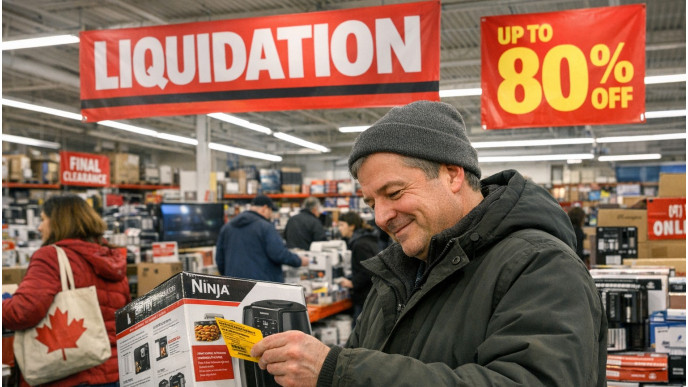
In the world of Canadian retail, "Everything Must Go!" is a siren song for deal hunters. Whether it’s a massive national chain shuttering its doors or a local "bin store" overflowing with Amazon returns, liquidation sales in Canada offer the promise of prices you simply won't find at a standard mall.
However, the reality of liquidation shopping is far more complex than just grabbing a cart and heading for the 70% off sign. From the closure of Mastermind Toys and Toys R Us locations to the bankruptcy of Bad Boy Furniture, Canadian consumers have had a front-row seat to the liquidation process recently. At Bargainmoose, we want you to save money without getting burned. This guide will walk you through the psychology of these sales, the legalities of "Final Sale" in Canada, and the strategies you need to ensure those "liquidated" goods are actually a bargain.
How Do Liquidation Sales Work?
Not all sales are created equal. In Canada, they generally fall into three categories:
- Store Closing Sales: When a retailer like The Body Shop Canada closes locations to restructure or exit the market.
- Product Liquidation Stores: Permanent retailers like Treasure Hunt or Bianca Amor’s Liquidation Centre that buy overstock, insurance claims, or shelf pulls from other retailers.
- Bin Stores: A newer phenomenon where stores sell "mystery" returns (often from Amazon or Target) at a flat daily price that drops throughout the week.
The insider secret? When a major chain goes bankrupt, the sale is rarely run by the retailer themselves. Instead, professional liquidation firms like Hilco Global or Gordon Brothers are brought in to manage the wind-down. Their goal is to maximize the recovery of assets for creditors, not necessarily to give you the lowest price on day one.
Are Liquidation Sales Worth It?
Are liquidation sales worth it? The short answer is yes, but only if you know how to play the game. The most common mistake savvy shoppers make is buying too early. Professional liquidators use a tiered discount strategy designed to play on your "FOMO" (Fear Of Missing Out).
Phase 1: The "Hype" Phase (10% to 20% Off)
In the first week of a store closing, discounts are often underwhelming. You might see "Up to 30% off," but a closer look reveals that most desirable items are only 10% off. Retailers often remove their usual "sale" or "clearance" prices and revert to the full Manufacturer's Suggested Retail Price (MSRP) before applying the liquidation discount. This can result in you paying more than you would have a week prior. We are seeing this strategy right now with Toys R Us.
Phase 2: The "Sweet Spot" (30% to 50% Off)
This usually occurs mid-way through the liquidation (around weeks 3 to 5). Selection is still decent, and the prices start to beat typical retail holiday sales. This is the best time to buy high-demand items like electronics or designer kitchenware.
Phase 3: The "Everything Must Go" Phase (70% to 90% Off)
The final 10 days are where the legendary deals live. However, you are often picking through the "bones" of the store. If you are looking for shelving, store fixtures, or niche accessories, this is your moment.
7 Pro Tips for Shopping Store Closing Sales
Liquidation shopping is a high-stakes environment. Once you cross that threshold, your standard consumer rights change. Here is how to protect your wallet.
1. Always Verify the Original Price (Don't Trust the Tags)
Never trust the "original" price on a liquidation tag. Use comparison apps like the Amazon App or Google Shopping to scan barcodes in real-time. If the "liquidation price" is $45 and the item is $38 online with free shipping, put it back.
2. Timing Your Visit: Early Selection vs. Late Deep Discounts
If you need something specific, go during the "Sweet Spot" phase (30-50% off). If you're just hunting for a bargain and don't care what you find, wait for the final week. Store closing sales are a gamble: wait too long and the item is gone; buy too early and you overpay.
3. Inspect Everything Closely (All Sales Are Final)
In Canada, while provincial laws generally protect consumers, liquidations are almost always "Final Sale." Under the Ontario Consumer Protection Act, retailers must clearly disclose that items are non-refundable. If the sign says "Final Sale," don't expect a refund if the item doesn't fit or you simply change your mind. Check for missing parts, dents, and scratches before you pay.
4. Use Price Comparison Apps While You Browse
Don't rely on your memory for pricing. Keep your phone out and active. Scan everything. Sometimes liquidation sales advertise huge percentage drops on items that were overpriced to begin with.
5. Understand What Happens to the Warranty
This is critical. If a store is closing, they cannot fulfil a store-level warranty. Usually, the manufacturer's warranty still applies to brand-new liquidated items, but some manufacturers specifically exclude "liquidation" or "as-is" sales from their coverage. According to the Better Business Bureau, shoppers should always verify if the manufacturer is still in business before relying on a warranty.
6. Beware of Shipped-In Inventory
A sneaky tactic? Liquidators sometimes bring in old merchandise from other warehouses or even different bankrupt companies to fill the shelves. Just because it's in a high-end store's closing sale doesn't mean it was originally sold there. Watch out for generic brands you don't recognize.
7. Bring Your Own Bags & Transportation
Going out of business sales often mean the store has stopped ordering supplies like bags. Bring your own. Also, delivery services usually stop immediately when liquidation begins. If you're buying furniture, bring a truck and a friend to help you load it.
Clearance Sales vs. Liquidation Sales: What's the Difference?
It's easy to confuse the two, but they are different beasts. Clearance sales in Canada events happen regularly when a store wants to move seasonal stock (like winter coats in March). The store is still open, return policies usually still apply (though sometimes stricter), and warranties are standard.
A liquidation sale means the store (or that specific location) is dying. The goal is cash recovery, not customer satisfaction. Policies are rigid, and "Final Sale" is the law of the land.
How to Find the Best Liquidation Store Near Me in Canada
To find the best deals, you need to know where the inventory is landing. If you are searching for a "liquidation store near me," here are the spots to check:
- Google Maps Search: Use terms like "liquidation stores Canada," "Surplus outlets," or "Discount warehouses" near you.
- Social Media Intelligence: Join local Facebook groups like "Toronto Pallet Liquidators" or "BC Deal Hunters." Community members often post photos of current stock levels at bin stores.
- Signage & Flyers: Keep an eye on commercial real estate signs. When a "Lease Available" sign goes up next to a "Store Closing" sign, the liquidators are usually in full swing.
Notable Canadian Liquidation Chains:
- Big Box Outlet Store (BC): Specializes in open-box electronics and furniture.
- Direct Liquidation: Known for mattress and furniture deals in Western Canada.
- Krazy Binz: A popular bin store chain with locations across Ontario, Manitoba and Alberta.
Strategies for Different Product Categories
Electronics and Appliances
When Bad Boy Furniture entered restructuring, many customers were left without deposits or deliveries. The Rule: Never pay a deposit for an item during a liquidation. If you can't take it home with you that day, don't buy it. Use a credit card for all purchases to ensure you can file a chargeback if the item is never delivered or is dead on arrival.
Clothing and Soft Goods
Wait for the 60% off mark. Clothing has the highest margins in retail, meaning a 20% discount is still likely higher than a standard end-of-season clearance price. Check every seam and zipper, as "liquidation" clothing often includes "irregulars" or "seconds."
Groceries and Consumables
Stores like modern surplus outlets often sell food near its "Best Before" date. In Canada, "Best Before" dates are about peak freshness, not safety (except for specific items like infant formula), according to the Canadian Food Inspection Agency. You can save 80% on dry goods, but always check the seals.
Verdict: How Liquidation Sales Work for You
How liquidation sales work is simple: they trade convenience and security for price. Liquidation shopping in Canada is a thrill for those who are prepared. It requires patience, a keen eye for quality, and a healthy dose of skepticism. By understanding that "Going Out of Business" is a managed financial process and not a charitable event, you can navigate the bins and aisles to find genuine savings.
Remember the Mooser Mantra: Verify the price, test the product, and never buy what you can't return unless the discount is deep enough to justify the risk. Happy hunting!
Frequently Asked Questions
Do manufacturer warranties apply at liquidation sales?
Usually, yes. If the item is sold as "new," the manufacturer's warranty typically applies from the date of purchase. However, some brands explicitly exclude goods sold "as is" or from unauthorized liquidators. Always check the manufacturer's policy before buying expensive electronics.
Can I return items bought at a store closing sale?
Almost never. Once a liquidation firm takes over, "All Sales Final" is the standard policy. You cannot return items for a refund, exchange, or store credit, even if they are defective. Inspect everything thoroughly before you pay.
Why are liquidation prices sometimes higher than regular prices?
Liquidators often reset prices to the full MSRP (Manufacturer's Suggested Retail Price) before applying a discount percentage. This means a "20% off" liquidation price might actually be higher than the store's previous "sale" price. Always compare prices with other retailers on your phone.