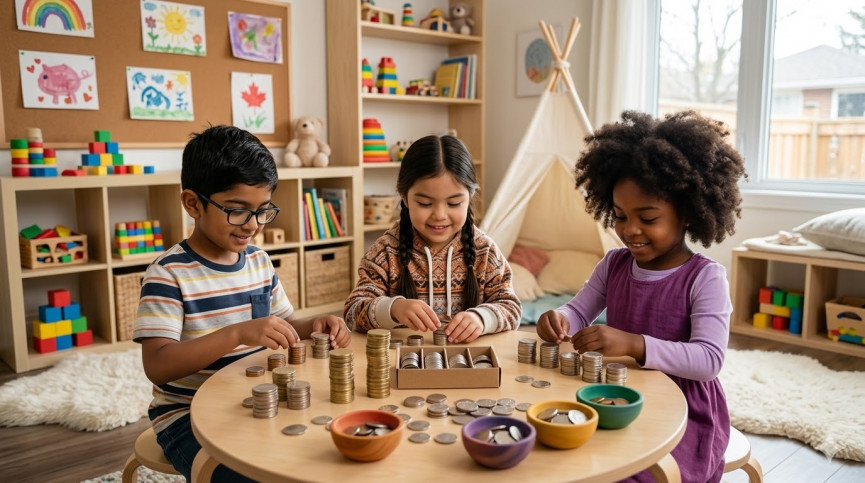
The average allowance by age that Canadian parents give follows a simple rule: roughly $1 per week for every year of your child's age. A 7-year-old gets $7 a week; a 12-year-old gets $12. But the amount is only part of the equation. This guide covers how much to give, which tools to use (including free digital options), and how to turn a weekly payout into an actual financial literacy for kids lesson.
Child Allowance Canada: The Two Main Approaches
Before deciding on a dollar amount, the bigger question is whether to tie allowance to chores or give it unconditionally. Both approaches have trade-offs.
Chores for Allowance (The "Salary" Model)
In this system, money is earned. If the chores don't get done, the allowance doesn't arrive. The upside: kids learn the connection between work and income. The downside: basic household tasks (clearing plates, making beds) become a negotiation rather than an expectation.
Unconditional Allowance (The "Citizen" Model)
The Financial Consumer Agency of Canada suggests that allowance works well as a learning tool rather than a payment for household contributions. The logic is that children should help out because they're part of the household, but they need their own money to practise budgeting and decision-making.
The Hybrid Approach
A third option: give a small, unconditional base allowance for learning purposes, then offer paid "bonus" tasks on top. Regular chores (making the bed, putting away dishes) are expected. Extra tasks (washing the car, deep-cleaning the garage, yard work) earn extra money. This gives kids both a reliable income to budget with and an opportunity to earn more when they want something specific.
Average Allowance by Age Canada: The $1-Per-Year Rule
The most widely cited benchmark for kids allowance Canada parents use is the "$1 per year of age per week" rule. CPA Canada and other financial literacy organizations reference this as a manageable starting point that scales with a child's growing needs.
Allowance Per Age Breakdown
| Age | Weekly Amount | Monthly Total | What It Covers |
|---|---|---|---|
| 5-6 | $5-$6 | $20-$24 | Small treats, saving toward a $20-$30 toy |
| 7-9 | $7-$9 | $28-$36 | Books, small toys, saving for larger items |
| 10-12 | $10-$12 | $40-$48 | Movie tickets, hobby supplies, gift shopping |
| 13-15 | $13-$15 | $52-$60 | Eating out with friends, clothing extras, entertainment |
| 16+ | $16+ | $64+ | Gas, phone costs, personal spending (many teens supplement with part-time work) |
These amounts are starting points. According to data reported by Mydoh, averages vary by region: parents in Ontario report paying around $23.90 per week for older children, while BC parents average closer to $17.80. Your household budget and cost of living will determine what makes sense.
How to Set Up a Chore Chart with Allowance
If you decide to tie some or all of the allowance to tasks, consistency matters more than the specific system. Whether you use a whiteboard on the fridge or a digital app, the key is: clear expectations, a set payday, and follow-through.
Age-Appropriate Chores
- Ages 5 to 8: Sorting laundry, putting away toys, watering plants, clearing their own plate, feeding pets with supervision.
- Ages 9 to 12: Loading and unloading the dishwasher, vacuuming, taking out recycling, helping with meal prep, organizing their own room.
- Teens (13+): Doing their own laundry, mowing the lawn, cleaning bathrooms, cooking simple meals, grocery shopping from a list.
For the hybrid approach, the tasks above would be the "expected" (unpaid) contributions. Bonus chores for extra money might include things like washing the car, cleaning out the garage, or raking leaves.

Allowance App Canada: Digital Tools for Managing Kids' Money
Cash is increasingly impractical for teaching kids about money in a world of tap-to-pay. Several Canadian-made apps let you automate allowance payments, assign chores, and give kids a prepaid card to practise spending and saving.
Mydoh App (by RBC)
The Mydoh app is the most established allowance app Canada families use. Owned by RBC, it pairs a Smart Cash Card (Visa prepaid) with a parent-controlled app.
- Cost: Free. No monthly subscription fee. The standard physical card is free; a custom-designed "Mydoh by Me" card costs $6.99 one-time. Up to 2 parents and 5 kids per account.
- How it works: Parents set tasks in the app. Kids mark them complete. Parents approve and release funds to the child's card. You can set spending limits and see every transaction in real time.
- Why it's useful: Kids get a physical card they can use at stores and online, which teaches real-world spending habits without the risk of overspending (it's prepaid, not credit).
BONUS: New accounts can use the MyDoh promo code MYD10 for a free cash bonus of $10.
TD Student Chequing Account
For families who prefer traditional banking, TD's Student Chequing Account is worth looking at. The account has no monthly fee, and TD is currently offering $50 cash plus a $25 Walmart gift card when you open a new account and meet certain criteria (like setting up a recurring deposit). That offer runs until June 29, 2026.
This works better for older kids and teens who are ready for a real bank account with a debit card, online banking, and the experience of managing an actual chequing account.
Teaching Kids to Stretch Their Allowance
Giving kids money is half the lesson. The other half is showing them how to make it go further. Here are three strategies that work at any age.
The Three-Jar System (Spend, Save, Give)
Even if your child uses a digital app, the underlying framework is the same: divide every allowance payment into three categories.
- Spend: Money for immediate wants (snacks, small toys, entertainment).
- Save: Money set aside for bigger goals (a new bike, a gaming console, a special outing).
- Give: Money for buying a friend's birthday gift or donating to a cause they care about.
A common split is 50/40/10 (spend/save/give), but the exact ratio matters less than the habit of dividing it every time.
The Wait-for-a-Sale Rule
If your child wants a specific toy, game, or piece of clothing, don't let them buy it the moment they have enough money. Show them how to check for sales at retailers like Toys R Us, Indigo, or Canadian Tire. If they wait for a 20% off sale on a $50 item, they save $10, which is essentially a free week of allowance back in their pocket.
Price Comparison Practice (For Older Kids)
Take your older kids grocery shopping and challenge them to find a lower price on an item using a flyer app or checking the unit price on the shelf tag. This builds the habit of comparing before buying, which pays off for the rest of their lives.
Ontario's New Financial Literacy Graduation Requirement
Starting with students who entered Grade 9 in the fall of 2024, Ontario now requires a financial literacy assessment as part of the Grade 10 math curriculum. Students must score 70% or higher on this assessment, which covers budgeting, saving, investing, and fraud protection, as a condition of graduating high school.
This makes financial literacy for kids more than a nice-to-have. If you're in Ontario, giving your child an allowance and teaching them to manage it gives them a head start on material they'll be formally tested on.
The Bottom Line
- The $1-per-year-of-age rule gives you a starting point for how much to give.
- Free tools like the Mydoh app make the logistics easy, even if you never carry cash.
- The real value of an allowance isn't the dollar amount; it's the chance for kids to practise budgeting, saving, and spending decisions with low stakes, so they're ready for higher-stakes financial choices later.
- Start small, stay consistent, and let them make a few mistakes along the way.
- A $12 impulse buy that breaks in an hour is a cheap lesson compared to a maxed-out credit card at 19.
Frequently Asked Questions
What is the average allowance by age in Canada?
The most common benchmark is $1 per week for every year of the child's age. A 10-year-old would get $10 per week. Regional averages vary: Mydoh reports Ontario parents pay around $23.90 per week for older kids, while BC parents average about $17.80.
Should allowance be tied to chores?
There's no single right answer. Tying allowance to chores for allowance teaches the work-income connection. Giving it unconditionally lets kids practise budgeting without the risk of losing their "learning money" for forgetting a task. Many families use a hybrid: a small base allowance plus paid bonus chores.
What age should I start giving an allowance?
Most financial experts suggest starting around age 5 or 6, when children understand basic counting and can grasp the concept of saving up for something. At this age, the amounts are small ($5 per week) and the lessons are simple: you can spend it now or save it for something bigger.
Is the Mydoh app free?
Yes. As of 2026, Mydoh has no monthly subscription fee. The standard physical Smart Cash Card is free. A custom-designed card costs $6.99 one-time. The account supports up to 2 parents and 5 children.